Oil tank removal timeline: what to expect
The two-to-four-week figure surprises people in both directions. Homeowners picturing weeks of machinery in the yard learn the digging takes one day. Sellers assuming a quick errand learn that permits and lab results — steps nobody controls from the driveway — consume most of the calendar. Here is the sequence, what each step produces, and where the schedule actually bends.
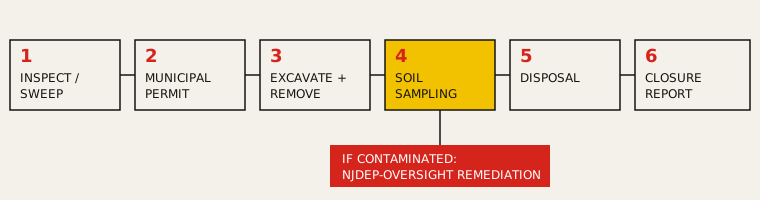
The timeline, step by step
| Step | What happens | Typical duration |
|---|---|---|
| Inspection / tank sweep | Locate and confirm the tank, size it, check access. Often same-week. | Days |
| Municipal permit | Contractor (usually) files with the construction office; town processes and schedules. | Days – few weeks |
| Excavation + removal | Tank exposed, pumped, pulled; municipal inspection at the open pit; backfill after sign-off. | Usually 1 day |
| Soil sampling | Samples taken from the pit and sent to the lab. | ~3–10 business days for results |
| Disposal | Tank scrapped/disposed with documentation. | Documented same-week |
| Closure report | Written record assembling permit, disposal receipt, and clean lab results. | On lab results |
Note what the table implies: the yard is disrupted for one day. The other two to four weeks are paperwork and waiting — permit queue on the front end, lab queue on the back end.
What each step produces
The timeline isn't just a schedule; it's a document trail. Each step should hand you paper, and the set of it is what answers every future question — from a buyer, a lender, an insurer, or the town.
- Sweep/inspection: a written finding of the tank's location and size.
- Permit: the municipal application and, at the end, the signed-off permit — proof the work was legal and inspected. (Who issues what, and when NJDEP enters: the permits guide.)
- Excavation: the municipal inspector's sign-off at the open pit, plus photos of the tank and pit if your contractor is thorough.
- Sampling: the lab report — the single most important document in the file.
- Disposal: a receipt showing where the tank went.
- Closure report: the assembled record. Keep it permanently; hand copies to your attorney at sale time.
A contractor's quote should show these deliverables as line items. If yours doesn't, read how to choose a contractor before signing anything.
What can go sideways
- The permit queue. Some towns turn permits around in days; others take weeks. This is the one step where the town you live in, not the contractor you hired, sets the pace.
- Utility mark-outs. Underground utilities must be marked before digging. Usually routine, occasionally the thing that pushes excavation day back.
- Residual oil, sludge, or fill. A tank with oil or sludge still in it means extra pumping and disposal. A tank that was sand- or foam-filled in an earlier closure means extra labor to cut and clear it. Both extend the one day on site; neither usually adds calendar weeks.
- Dirty soil — the big one. A contaminated sample pauses closure entirely and opens a remediation case under NJDEP oversight, with its own timeline and its own budget. Everything about that branch is in the leak and remediation guide.
- Weather. Frozen ground, saturated soil, and storms move excavation days. Winter jobs carry more schedule risk than summer ones.
Where the schedule can actually be compressed
Most of the calendar sits in queues you don't control, but three choices at the start move the finish date:
- Hire a contractor who files the permit immediately. The permit application should go in the week you sign, not after the crew has an opening. Days lost at the front of the chain are unrecoverable at the back.
- Ask about lab turnaround when you hire, not after the dig. The 3–10 business day range is wide; knowing which end your contractor's lab typically hits sets your expectations for the closure report.
- Book the sweep and the estimate in the same week. Confirming the tank and pricing the job are fast steps; letting them straggle across weeks adds calendar for no reason.
What you cannot compress: the town's processing time, the lab's chemistry, and — if the sample is dirty — anything at all. Skipping sampling to "save time" removes the one document the whole exercise exists to produce.
Scheduling advice for sellers
If a sale is anywhere on your horizon, the timeline stops being trivia and becomes leverage. Start the process before listing. The document your buyer's attorney will demand — a closure report backed by clean soil results — sits at the end of a chain whose slowest links, the permit office and the lab, do not care about your closing date. Lab turnaround is the long pole: nothing closes until results are back, and results take the 3–10 business days they take.
A seller who starts early lists a house with a solved problem and a complete file. A seller who starts under contract is negotiating every day of lab turnaround against a closing date. The full playbook — timing, disclosure, and who pays for what — is in selling a house with an oil tank in NJ and the seller situation page.
Under contract already? Count backward from closing: two to four weeks for a clean removal, and no ceiling if the sample comes back dirty. A contamination finding mid-contract converts a scheduling problem into a renegotiation. Start the permit application now, and do not let anyone compress the schedule by skipping soil sampling — a closure without lab results solves nothing.
Next step
The schedule above assumes a contractor who files the permit promptly, digs once, and documents everything. Price the job with the cost estimator, then let us match you with an independent, licensed, NJDEP-compliant contractor who can put excavation day on the calendar.