New York: the biggest oil-tank market in the country's densest corridor
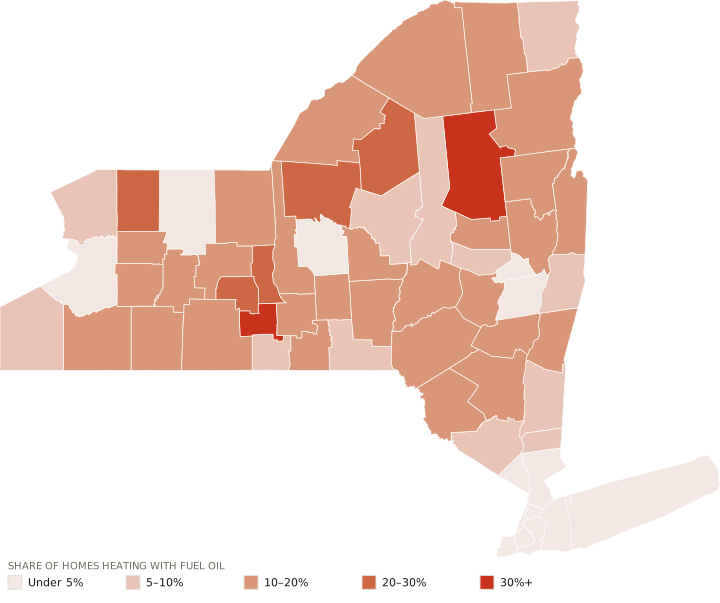
380,145 New York homes still heat with oil. That is more than New Jersey, Connecticut, and Massachusetts combined, and it splits into two markets that barely resemble each other. Upstate, oil heat is a share story: in Hamilton County nearly a third of homes burn oil because the gas grid never arrived. Downstate, it's a volume story: Long Island and Westchester hold the region's largest concentration of aging buried tanks in absolute numbers, sitting under some of the most expensive residential land in America. Same tank, very different stakes.
Census ACS 2020–2024, table B25040.
What it costs in New York
| Line item | Typical range |
|---|---|
| Underground removal, clean soil | $1,700–$4,500 |
| Difficult access | up to ~$5,000 |
| Closure in place | $1,000–$2,500 |
| Tank sweep | $150–$500 |
| Soil sampling and lab analysis | $300–$1,000 |
| Remediation if a leak is confirmed | $3,000–$15,000; most residential $8,000–$10,000; severe $100,000+ |
Why New York tops the regional range: downstate labor rates, disposal hauls that get long once you're east of the Nassau line, and Long Island's high water table, which puts groundwater within reach of a leaking tank and raises the stakes on every soil sample. Westchester adds rocky ground and tight, terraced lots where an excavator can't simply drive to the tank. Upstate quotes land lower — often near the bottom of the range — but sparse contractor coverage in rural counties can offset the savings with mobilization fees. Permits are municipal and run $50–$500; Long Island townships are accustomed to these jobs and process them routinely.
Who regulates what
The New York State Department of Environmental Conservation (NYSDEC) owns the contamination side of this problem. New York's rule worth memorizing: a petroleum spill — heating oil included — should be reported to the DEC spill hotline (1-800-457-7362) within two hours of discovery. In practice, when a removal turns up stained soil, your contractor calls the hotline from the excavation, the spill gets a number, and the site stays an open DEC case until cleanup standards are met and the case is closed. That closure paperwork is what future buyers' attorneys will demand, so keep every page.
The removal itself, for a residential heating tank, is permitted locally — town or village building department, sometimes the fire marshal. New York also has something New Jersey lost: the state's Environmental Protection and Spill Compensation Fund, administered by the Office of the State Comptroller, which can pay cleanup costs when a responsible party can't and then pursue reimbursement. It is not a grant program and it is not automatic — how it actually behaves for homeowners is covered on our NY financial relief page.
The reporting clock starts at discovery, not at your convenience, and it applies to homeowners as much as contractors. This is a reason to hire a firm that removes tanks weekly rather than occasionally: an experienced crew makes the hotline call correctly, describes the release accurately, and keeps a minor spill number from being written up like a major one. The report itself is not the disaster — an unreported release found later is far worse for you, because the record then shows concealment instead of compliance.
The transaction reality
Downstate New York real estate treats a buried oil tank the way it treats a wet basement: a priced defect. Tank sweeps are standard practice in Nassau, Suffolk, and Westchester purchases, and buyer attorneys routinely condition contracts on removal with clean end-point samples. Insurers apply the sharpest pressure in this state — a number of carriers writing Long Island homes decline coverage or exclude oil releases when a buried tank is present, and a home a buyer can't insure is a home a buyer can't finance. Oil-to-gas conversion quotes are a common trigger too: the utility hookup goes in, and the old tank becomes a question someone eventually has to answer.
The seller math is the same as everywhere, only with bigger numbers. On a $900,000 Westchester listing, a $3,000 pre-listing removal with a clean report is noise; an open DEC spill number discovered in contract is a renegotiation. If the tank is coming out eventually — and in this market it is — the cheapest version is the one you schedule yourself.
Where to go from here
- Find NY tank contractors — coverage from Montauk to the Southern Tier, and what to check before hiring.
- NY financial relief — the Spill Fund, insurance angles, and what actually pays.
- Tank sweep — settle whether that 1958 colonial still has steel under the lawn.
- Underground tank removal — the full job, from permit to lab report.
- Cost estimator — a localized range in about a minute.
When you're ready for real numbers instead of ranges, the contractor contact form matches you with licensed New York contractors who work your county.